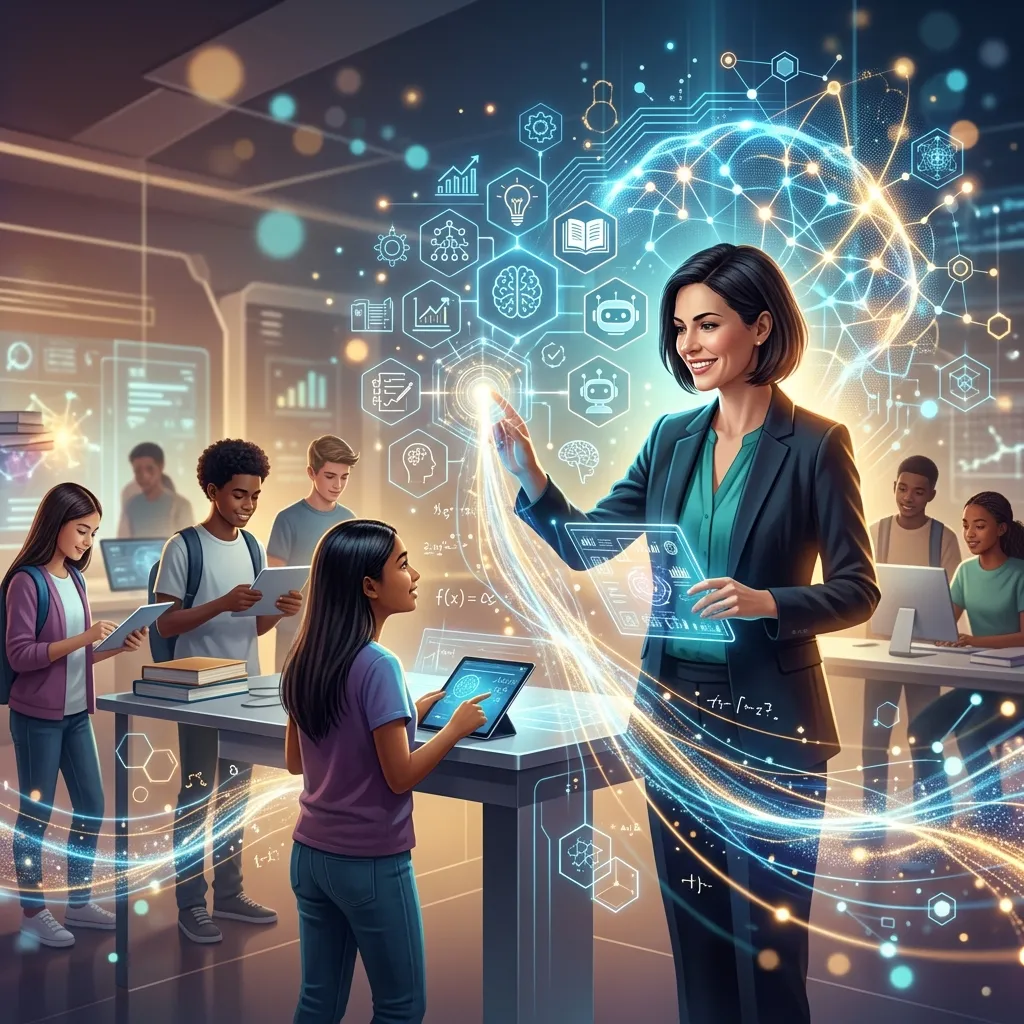
A school bell rings in a government classroom somewhere in Rajasthan. Students settle down, notebooks open, chalk dust still hanging in the air. The teacher walks in—but instead of starting with a lecture, she opens a tablet.
Not to replace teaching.
To survive it.
On the screen, a lesson plan is already structured. Quizzes are auto-generated. One student’s weak areas are highlighted in soft red. A homework assignment has been translated into Hindi and English automatically. Attendance is already marked using facial recognition from the classroom camera.
She hasn’t even spoken yet.
This is not a futuristic classroom. This is 2026 reality in many schools experimenting with AI quietly, unevenly, sometimes chaotically—but undeniably.
And the role of the teacher is changing faster than the syllabus itself.
- 1The classroom didn’t change first. The workload did.
- 2AI in education isn’t a single tool—it behaves more like an invisible staff room
- 1. Planning assistant
- 2. Assessment engine
- 3. Student behavior tracker
- 4. Language bridge
- 5. Administrative automator
- 3A real classroom moment: when AI noticed what the teacher missed
- 4Where AI actually helps teachers (beyond hype)
- Lesson preparation becomes lighter
- Differentiated learning becomes possible
- Feedback becomes faster and more specific
- Parent communication becomes structured
- 5The uncomfortable truth: teachers are becoming designers of learning systems
- 6Myths vs reality: AI in education
- Myth 1: AI will replace teachers
- Myth 2: AI makes learning effortless
- Myth 3: AI creates cheating problems only
- Myth 4: AI works the same in every school
- 7India’s education system and AI: a complicated match
- 8The hidden risk nobody talks about enough
- Over-dependence on suggestions
- Data misinterpretation
- Standardization of thinking
- Privacy concerns
- 9A day in a modern AI-assisted classroom
- 10Opinion: the real transformation is not technical, it’s emotional
- 11Practical advice for educators stepping into AI tools
- 12A quiet shift already underway
The classroom didn’t change first. The workload did.
If you ask most educators what drains them, the answer is rarely “teaching.”
It’s everything around teaching.
- Lesson planning after school hours
- Checking assignments late at night
- Writing remarks for each student
- Repeating the same explanation 10 different ways
- Administrative reporting that never ends
A teacher in Mumbai once described it like this:
“I don’t finish my job when the bell rings. That’s when my second job starts.”
AI entered education not as a revolution, but as relief for that second job.
AI in education isn’t a single tool—it behaves more like an invisible staff room
The biggest misunderstanding is thinking AI for teachers is just “ChatGPT for lesson plans.”
That’s only one tiny layer.
In real classrooms using AI today, the system is split into multiple roles:
1. Planning assistant
AI generates lesson structures based on curriculum, difficulty level, and student age. Not static notes—adaptive plans that change if the class struggles.
2. Assessment engine
It doesn’t just grade answers. It analyzes how a student reached the answer. Step-by-step reasoning becomes visible.
3. Student behavior tracker
Not surveillance in a scary sense, but pattern detection:
- attention drops
- participation changes
- consistent mistakes in specific topics
4. Language bridge
In India especially, this is huge. AI translates explanations instantly into regional languages without losing context.
5. Administrative automator
Attendance, report cards, parent messages, exam scheduling—tasks that used to consume weekends.
Individually, these look small. Together, they quietly restructure the entire profession.
A real classroom moment: when AI noticed what the teacher missed
In a private school in Bengaluru, a Class 8 math teacher noticed something unusual.
One student consistently performed well in tests but rarely participated in class. No disciplinary issues, just silence.
The AI system flagged a subtle pattern: the student was solving problems correctly but taking unusually long breaks between steps in handwritten work submissions.
The teacher investigated gently. Turned out the student had anxiety during oral questioning and feared making mistakes in front of peers.
The solution wasn’t academic tutoring. It was changing how the student was asked questions.
That small adjustment improved participation within weeks.
The teacher later said something simple:
“I knew the student. I just didn’t see the pattern.”
Where AI actually helps teachers (beyond hype)
Forget the marketing language. In real classrooms, AI is most useful in boring places.
Lesson preparation becomes lighter
Instead of starting from scratch, teachers refine drafts. More time goes into how to explain, less into what to explain.
Differentiated learning becomes possible
One class, thirty students, thirty different speeds. AI helps create multiple difficulty levels for the same topic.
Feedback becomes faster and more specific
Instead of “good work” or “revise this,” students get pinpointed guidance:
- “Your calculation is correct but reasoning step 3 is missing clarity”
- “You understand concept A but confuse it with B”
Parent communication becomes structured
Instead of emotional or rushed messages, updates become data-backed and clearer.
The uncomfortable truth: teachers are becoming designers of learning systems
This is where things get interesting—and a little uncomfortable.
Teachers are no longer only delivering knowledge.
They are increasingly:
- curating AI-generated content
- validating automated assessments
- adjusting algorithmic suggestions
- deciding when not to trust the system
In simple terms, teaching is becoming a hybrid role: educator + system operator.
Some teachers adapt quickly. Others feel replaced in small, invisible ways.
A senior educator in Delhi put it bluntly:
“I didn’t become a teacher to supervise software.”
That sentence reflects a deeper tension in education right now.
Myths vs reality: AI in education
There’s a lot of noise around this topic. Let’s separate it cleanly.
Myth 1: AI will replace teachers
Reality: It struggles with emotional intelligence, classroom energy, and unpredictable human behavior.
Myth 2: AI makes learning effortless
Reality: It makes access easier, but learning still requires discipline and guidance.
Myth 3: AI creates cheating problems only
Reality: It also creates transparency in understanding student thinking when used properly.
Myth 4: AI works the same in every school
Reality: Infrastructure, training, and access completely change outcomes.
India’s education system and AI: a complicated match
India is not a single classroom—it’s millions of different realities.
In urban private schools, AI is used for:
- smart grading systems
- digital classrooms
- adaptive tests
In semi-urban schools, it often starts with:
- WhatsApp-based learning assistants
- translation tools
- basic quiz generators
In rural areas, the biggest impact is simpler:
- reducing language barriers
- helping teachers prepare structured notes faster
- bridging content gaps where textbooks fall short
The gap is not just technological. It’s infrastructural and human.
The hidden risk nobody talks about enough
AI in education is not only about efficiency. It comes with subtle risks.
Over-dependence on suggestions
If lesson plans are always generated, creative teaching methods can shrink over time.
Data misinterpretation
A student’s “low engagement” might be tiredness, not lack of interest. AI doesn’t always know context.
Standardization of thinking
If every teacher uses similar AI systems, teaching styles may slowly become uniform.
Privacy concerns
Student data—performance, behavior, communication—is extremely sensitive. Not every system handles it responsibly.
A day in a modern AI-assisted classroom
Picture this—not as science fiction, but a growing reality:
Morning starts with attendance automatically logged.
The teacher receives a dashboard:
- 4 students struggling with fractions
- 2 students showing sudden drop in participation
- 1 student excelling beyond curriculum pace
During class, AI quietly suggests:
- alternative explanation methods
- real-time quizzes
- visual aids based on confusion patterns
After class:
- homework auto-generated
- feedback drafts prepared
- parent updates queued
The teacher doesn’t disappear.
They just stop drowning in repetitive tasks.
Opinion: the real transformation is not technical, it’s emotional
There’s a tendency to focus on tools—apps, dashboards, platforms.
But the real shift is emotional capacity.
When administrative overload reduces, teachers regain something they slowly lost over the years: patience.
Patience to notice a quiet student.
Patience to re-explain a concept differently.
Patience to actually listen instead of rushing to the next task.
One teacher in Kerala described it beautifully:
“AI didn’t make me smarter. It made me calmer.”
That’s not a technological metric. That’s a human one.
Practical advice for educators stepping into AI tools
No complex roadmap needed. Just a grounded approach.
Start with tasks that repeat daily:
- grading objective answers
- generating worksheets
- translating notes
- organizing lesson plans
Then slowly move into:
- student performance tracking
- adaptive assignments
- AI-assisted feedback writing
Avoid jumping directly into advanced predictive systems without understanding basics.
And most importantly—never outsource judgment.
AI can suggest patterns. Teachers decide meaning.
A quiet shift already underway
Education is not being replaced.
It is being reorganized.
Blackboards still exist. Conversations still matter. Human intuition still leads.
But behind the scenes, a layer of intelligence is now assisting quietly—sorting, drafting, suggesting, organizing.
Not to make teaching less human.
But to make it less overwhelmed.
And in many classrooms, that change is already visible—not in the technology itself, but in something much simpler:
teachers finally looking up from paperwork and back at their students.