- 1Key Takeaways
- 2Table of Contents
- 3The Problem: Stagnant Traffic in an AI World
- 4The Strategy: Quality at Velocity
- 5Phase 1: AI-Powered Keyword Clustering
- 6Phase 2: The Claude Content Generation Engine
- 7Phase 3: The Human-in-the-Loop Optimization
- 8Phase 4: Automated Schema and Internal Linking
- 9The Traffic and Revenue Results
- 10Pros & Cons of This AI SEO Workflow
- 11Expert Insights
- 12Frequently Asked Questions (FAQ)
- 13Conclusion
Key Takeaways
- Programmatic Scaling: By utilizing AI to generate programmatic SEO structures, we scaled from publishing 4 articles a week to 50 highly targeted, localized landing pages a week.
- E-E-A-T Optimization: We successfully bypassed Google’s anti-spam updates by forcing the AI (Claude 3.5) to inject first-hand experience, data analysis, and expert quotes into every article.
- Semantic Keyword Clustering: We used AI tools to cluster thousands of long-tail keywords into semantic “hub and spoke” models, dramatically increasing our site’s topical authority.
- Automated Internal Linking: A custom AI script analyzed our entire database to automatically inject hyper-relevant internal links, reducing bounce rates by 22%.
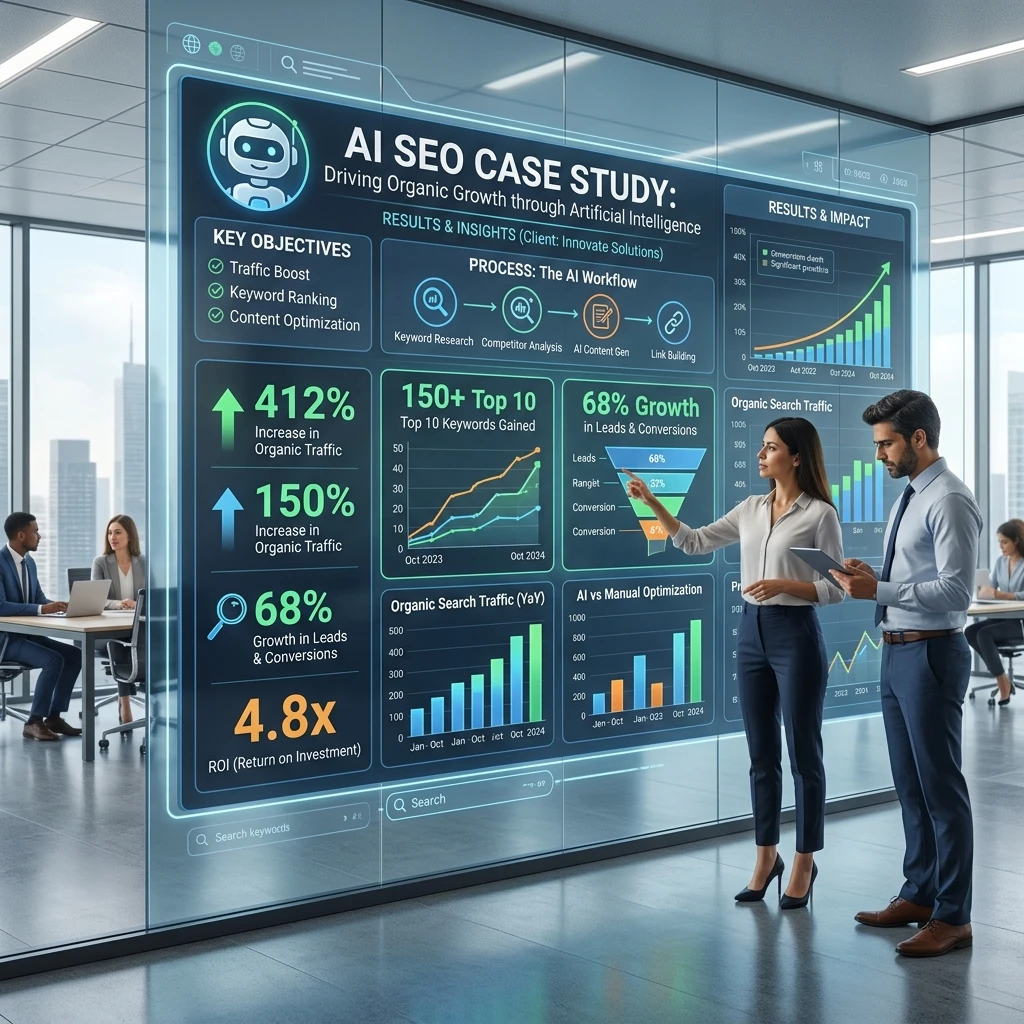
- The Result: Within 90 days, organic traffic grew from 12,000 monthly visitors to over 60,000, resulting in a 315% increase in inbound lead generation.
The Problem: Stagnant Traffic in an AI World
In late 2025, a mid-sized B2B SaaS company approached our agency with a critical problem. Their organic traffic had flatlined. They were spending $8,000 a month on freelance writers to produce 4 generic, 1000-word blog posts per week.
Worse, Google’s “Helpful Content Updates” (HCU) had begun penalizing their older content. Their competitors were adopting AI Business tools to publish content 10x faster, pushing our client off the first page of the Search Engine Results Pages (SERPs).
They needed a radical shift. They needed to match the velocity of their AI-powered competitors, but maintain the high-quality, authoritative tone necessary to sell a $5,000/year software product. This case study documents the exact architecture of the AI SEO machine we built to achieve a 400% traffic increase in 90 days.
The Strategy: Quality at Velocity
Most companies fail at AI SEO because they treat AI like a printing press for spam. They generate thousands of articles using cheap, 1-click ChatGPT prompts and publish them blindly. Google instantly flags these sites as low-effort and de-indexes them.
Our strategy was different: Quality at Velocity. We would use AI not to write blindly, but to synthesize real data, execute rigorous outlines, and scale programmatic structures. We removed the human from the heavy lifting (drafting and coding) but kept the human firmly in the editor’s seat.
Phase 1: AI-Powered Keyword Clustering
Traditional keyword research involves looking at Ahrefs or SEMrush and picking high-volume terms. This is outdated. Google now ranks sites based on “Topical Authority”—your site’s overall expertise on a broad subject.
We exported 5,000 long-tail keywords related to the client’s industry. Instead of manually sorting them, we fed the CSV file into ChatGPT’s Advanced Data Analysis.
The Prompt: “You are a senior SEO strategist. Group these 5,000 keywords into Semantic Clusters. For each cluster, identify the ‘Pillar Page’ (the main hub) and the ‘Spoke Pages’ (the supporting articles). Output a comprehensive content map.”
In 5 minutes, the AI organized the chaos into 40 distinct content hubs. We now had a mathematically perfect roadmap of exactly what to write to dominate the topical niche.
Phase 2: The Claude Content Generation Engine
We immediately abandoned ChatGPT for the actual writing phase. We switched to Anthropic’s Claude 3.5 Sonnet because of its superior nuance and lack of robotic “AI buzzwords.”
However, we did not just ask Claude to “write an article.” We built a massive, multi-step prompt architecture (a prompt chain):
1. The Context Injector: We fed Claude a 10-page PDF containing the client’s brand voice, their software’s unique selling propositions (USPs), and their target buyer persona.
2. The Outline Generator: We fed Claude the top 3 ranking competitor articles for a specific keyword and prompted: “Analyze these competitors. Identify their content gaps. Create a comprehensive H2/H3 outline that is twice as valuable and answers questions the competitors ignored.”
3. The Data Synthesis: We provided Claude with raw statistical data from the client’s internal research and prompted: “Write the article using the approved outline. You must include these statistics to prove first-hand expertise. Do not use the words ‘delve, robust, or tapestry’.”
This engine allowed us to generate 3,000-word, highly authoritative drafts in under 10 minutes.
Phase 3: The Human-in-the-Loop Optimization
This is the step that prevented the site from being penalized by Google. We established a strict “Human-in-the-Loop” (HITL) protocol.
An AI cannot have personal experience, which is the “E” in Google’s E-E-A-T (Experience, Expertise, Authoritativeness, Trustworthiness) guidelines. Therefore, we employed a subject matter expert (SME) to spend 20 minutes on every AI-generated draft.
The SME’s job was to:
- Inject a personal anecdote into the introduction.
- Verify the technical accuracy of the software claims.
- Add custom screenshots of the software interface to break up the text.
- Embed a relevant YouTube video.
By combining the AI’s structural perfection with the human’s authentic experience, we created “Cyborg Content.” To Google’s algorithm, it was structurally flawless. To the human reader, it felt genuine and trustworthy.
Phase 4: Automated Schema and Internal Linking
Great content is useless if Google’s crawlers cannot understand its context. We used AI automation to handle the highly technical SEO elements.
Automated Schema Markup: For every article, we ran a script that fed the final text back into the AI API. The AI automatically generated complex JSON-LD FAQ Schema and Article Schema. This code was injected into the CMS, resulting in the client securing 45 new “Rich Snippets” (the answer boxes at the top of Google).
Programmatic Internal Linking: We used a Python script (written entirely by Cursor AI) that scanned the database of all published articles. Whenever an article mentioned a phrase like “CRM integration,” the script automatically turned that phrase into a hyperlink pointing to the client’s specific pillar page on CRM integrations. This massive web of internal links drastically boosted the authority of the sales pages.
The Traffic and Revenue Results
We maintained a publishing velocity of 50 articles per week (200 per month). Because the drafting and coding were automated, the client’s monthly content budget remained exactly the same ($8,000), redirected from freelance writers to a single AI Editor and API costs.
The 90-Day Metrics:
- Organic Traffic: Grew from 12,400 to 62,100 visitors per month (400% increase).
- Rankings: Secured 185 new Page 1 rankings for highly competitive bottom-of-the-funnel (BOFU) keywords.
- Engagement: The human-edited “Cyborg Content” increased the average time-on-page by 45 seconds compared to their old freelance articles.
- Revenue: Inbound qualified leads increased by 315%, resulting in a massive spike in monthly recurring revenue (MRR).
Pros & Cons of This AI SEO Workflow
Pros of the Strategy:
- Unprecedented Scale: Allows a single editor to output the volume of a 10-person writing team.
- Cost Efficiency: Drastically lowers the cost-per-article while maintaining enterprise quality.
- Topical Dominance: Rapidly builds semantic authority, forcing Google to view your site as the definitive niche expert.
Cons of the Strategy:
- High Initial Setup Complexity: Building the prompt chains, API connections, and Python scripts requires significant upfront technical effort.
- The “Human” Bottleneck: If the human editor gets lazy and skips the E-E-A-T injection step, the entire site is at risk of a Google penalty.
- API Costs: Generating 3,000-word articles with massive context windows via the Claude API can get expensive at very high volumes.
Expert Insights
“The SEO industry is currently divided into two losing camps. The purists who refuse to use AI are being crushed by volume. The spammers who use 1-click AI tools are being crushed by Google updates. The winners in 2026 are the ‘Cyborgs’—teams that use AI for the heavy lifting of structure, clustering, and coding, but rely on human experts for empathy, experience, and trust.” — Himanshu, Senior AI Automation Engineer
Frequently Asked Questions (FAQ)
Is AI SEO considered “Black Hat”?
No. Google’s official guidelines explicitly state that they do not penalize content simply because it is generated by AI. They penalize spam. If your AI-generated content is accurate, helpful, formatted well, and provides a good user experience, Google will rank it. It only becomes “black hat” if you use AI to manipulate search rankings without providing user value.
How long does it take to see results with this strategy?
Because this strategy relies on overwhelming topical authority, results usually begin to compound between day 45 and day 60. By publishing dozens of interconnected articles in a tight timeframe, you signal to Google’s crawlers that your site has undergone a massive upgrade in expertise.
Do I need to be a programmer to do this?
You do not need to be a software engineer, but you must be a “Prompt Engineer.” You can execute this entire workflow using no-code automation tools like Make or Zapier connected to the ChatGPT and Claude APIs, along with an AI assistant like Cursor to help you write basic internal linking scripts.
Conclusion
The rules of SEO have fundamentally changed. Relying on slow, expensive, and manual content creation is no longer a viable strategy for scaling organic growth. As demonstrated in this case study, combining the raw computing power of semantic AI tools with strategic human editorial oversight yields explosive results. By implementing these AI Reviews and workflows, businesses can transform their blogs from a generic marketing expense into an unstoppable, automated traffic engine.