- 1Key Takeaways
- 2Table of Contents
- 3The Divergence of AI Tools
- 4Deep Dive: ChatGPT (GPT-4o)
- The Brainstorming Partner
- Multimodal Mastery
- 5Deep Dive: Perplexity AI (Pro)
- The “Anti-Hallucination” Engine
- Focus Modes
- 6Head-to-Head: Web Browsing & Research
- 7Head-to-Head: Creative Writing & Ideation
- 8Head-to-Head: Coding & Development
- 9Pros & Cons: ChatGPT vs. Perplexity
- 10Comparison Table: Feature by Feature
- 11Expert Verdict
- 12Frequently Asked Questions (FAQ)
- 13Conclusion
Key Takeaways
- Different Core Functions: ChatGPT is primarily a “Generative” engine designed to write, code, and brainstorm. Perplexity is an “Answer” engine designed to search the live web and synthesize facts.
- The Hallucination Factor: ChatGPT often invents facts when it doesn’t know the answer. Perplexity strictly relies on scraped web data, providing footnote citations for every claim to eliminate hallucinations.
- Creative Writing vs. Academic Research: If you need to write a blog post or a sales email, ChatGPT wins. If you need to research a medical journal or track live stock prices, Perplexity wins.
- User Interface: ChatGPT uses a traditional conversational chat window, whereas Perplexity features a clean, research-focused UI with related questions, image searches, and direct source links.
The Divergence of AI Tools
When ChatGPT first launched, it was treated as a digital oracle—a single tool you could use to write code, compose poetry, and ask historical questions. However, users quickly realized a major flaw: LLMs are designed to predict the next logical word, not to tell the truth. If they don’t know a fact, they will confidently invent one (a hallucination).
This flaw birthed a new category of AI: The Answer Engine. The undisputed leader of this category is Perplexity AI.
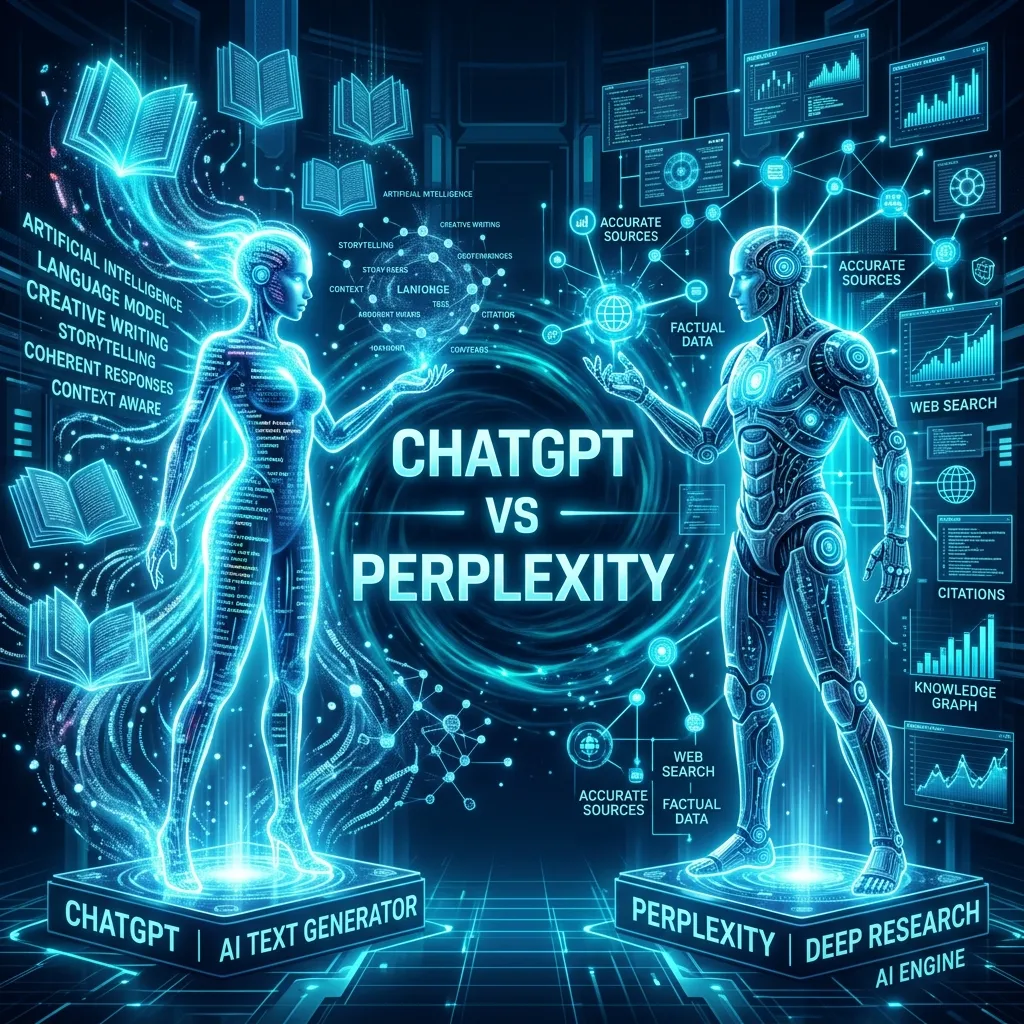
In 2026, comparing ChatGPT and Perplexity is like comparing a master novelist to an elite investigative journalist. They both use words, but their goals are entirely different. AI Business leaders must understand this divergence to build an effective tech stack. You do not choose between them; you use them for entirely different phases of your workflow.
Deep Dive: ChatGPT (GPT-4o)
Created by OpenAI, ChatGPT remains the most popular consumer AI in the world. Powered by the incredibly fast GPT-4o model, it is the ultimate creative assistant.
The Brainstorming Partner
ChatGPT excels in scenarios where there is no “correct” answer. If you are staring at a blank page and need 20 catchy headlines for a YouTube video, ChatGPT will generate them instantly. If you need to translate a complex Python script into JavaScript, or write a polite email declining a job offer, ChatGPT executes flawlessly.
Multimodal Mastery
ChatGPT has heavily invested in voice and vision capabilities. You can open the ChatGPT app, point your camera at a broken bicycle chain, and have a real-time voice conversation with the AI about how to fix it. This level of interactive, multimodal assistance is completely absent in Perplexity.
Deep Dive: Perplexity AI (Pro)
Perplexity, while powered by LLMs (including models from OpenAI and Anthropic), operates on a completely different architecture known as RAG (Retrieval-Augmented Generation).
The “Anti-Hallucination” Engine
When you ask Perplexity a question, it does not immediately answer based on its training data. Instead, it pauses, searches the live internet, reads the top 10 to 20 websites, and synthesizes that exact information. Most importantly, it appends a clickable footnote [1] to every single sentence. If you ask Perplexity for the current CEO of a company, it will give you the answer and link directly to the press release from today.
Focus Modes
Perplexity features “Focus Modes” that allow you to restrict its search. You can tell it to only search academic papers, only search Reddit, or only search YouTube transcripts. This allows researchers to bypass the SEO spam of Google and find hyper-specific data instantly.
Head-to-Head: Web Browsing & Research
Winner: Perplexity AI.
While ChatGPT Plus does have a “Browse with Bing” feature, it is often slow, clunky, and fails to read complex websites. Perplexity was built from the ground up for search. It is lightning-fast, highly accurate, and the footnote UI makes fact-checking effortless. If you are doing market research, academic study, or financial analysis, Perplexity is infinitely superior.
Head-to-Head: Creative Writing & Ideation
Winner: ChatGPT.
Perplexity is an investigative journalist; it sticks to the facts. If you ask Perplexity to “write a funny science fiction story about a cat,” it will do it, but it will be dry. ChatGPT is designed for creativity. It understands narrative structure, humor, pacing, and emotional tone. For copywriting, blogging, and creative writing, ChatGPT is the clear winner.
Head-to-Head: Coding & Development
Winner: ChatGPT.
Perplexity can search for coding solutions on StackOverflow, but it struggles with complex, multi-file code generation. ChatGPT features “Advanced Data Analysis,” allowing you to upload CSV files, run Python code natively within the chat, and generate complex architectural structures. For software engineers, ChatGPT (or Anthropic’s Claude) remains the standard.
Pros & Cons: ChatGPT vs. Perplexity
Pros of ChatGPT (GPT-4o):
- Elite creative writing and brainstorming capabilities.
- Powerful “Advanced Data Analysis” for executing Python code and creating charts.
- Unmatched voice and vision features via the mobile app.
Cons of ChatGPT:
- Highly prone to hallucinations when asked factual or historical questions.
- The web browsing feature is slow and often fails to bypass simple paywalls.
- UI can become cluttered with long, unorganized chat histories.
Pros of Perplexity AI:
- The absolute best tool on the market for factual research and web synthesis.
- Provides immediate, clickable citations for every claim, ensuring trust.
- “Pro Search” asks you clarifying questions to narrow down complex queries.
Cons of Perplexity AI:
- Useless for creative writing, fiction, or nuanced copywriting.
- Cannot run code or natively analyze massive Excel spreadsheets.
- Relies entirely on the quality of the websites it scrapes (garbage in, garbage out).
Comparison Table: Feature by Feature
| Feature | ChatGPT Plus | Perplexity Pro |
|---|---|---|
| Subscription Cost | $20 / month | $20 / month |
| Primary Use Case | Content Creation, Ideation, Coding | Deep Research, Fact-Finding, Search |
| Live Web Browsing | Yes (Often slow/buggy) | Yes (Lightning fast, core feature) |
| Citation Quality | Poor (Often invents links) | Excellent (Direct, clickable footnotes) |
| Image Generation | Yes (DALL-E 3) | Yes (Uses DALL-E or Stable Diffusion) |
| Voice Conversation | Yes (Real-time conversational voice) | No (Text-to-speech only) |
| Data Analysis | Native Python execution | None |
Expert Verdict
“Stop trying to use one AI tool for everything. If you are facing a blank page and need to create something from nothing—an email, a script, a block of code—use ChatGPT. If you have a specific question and need factual, verifiable data from the live internet, use Perplexity. A modern professional needs both tabs open at all times.” — Himanshu, Senior AI Automation Engineer
Frequently Asked Questions (FAQ)
Does Perplexity use ChatGPT’s technology?
Yes and no. Perplexity is model-agnostic. In the free version, it uses its own proprietary models. In the Pro version, you can actually open the settings and choose which model powers your searches: you can select OpenAI’s GPT-4o, Anthropic’s Claude 3.5, or open-source models like Llama 3.
Is Perplexity trying to replace Google?
Yes. Perplexity is explicitly positioning itself as a “Google Killer.” Instead of making users scroll through 10 pages of ad-heavy search results to find a recipe or a fact, Perplexity reads the pages and gives the user the direct answer.
Can I cancel my ChatGPT subscription and just use Perplexity Pro?
If you primarily use AI for research and answering questions, yes. Because Perplexity Pro allows you to use the GPT-4o model, you get the intelligence of ChatGPT wrapped in Perplexity’s research UI. However, if you rely on ChatGPT’s Advanced Data Analysis, voice mode, or custom GPTs, you will need to keep your ChatGPT subscription.
Conclusion
The debate between ChatGPT and Perplexity highlights the maturation of the AI industry. We have moved from a novelty phase into a utility phase. ChatGPT remains the ultimate creative engine, a tireless brainstorming partner that can write code and poetry with equal skill. Perplexity, however, has revolutionized how we access human knowledge, cutting through the noise of the modern internet to deliver cited, factual truth. To maximize your productivity, you must master the art of knowing exactly which tool to deploy for the task at hand. Explore more in-depth analyses in our AI Reviews directory.