- 1Key Takeaways
- 2Table of Contents
- 3The AI Art Revolution
- 4Deep Dive: Midjourney (v6)
- The “Aesthetic Default”
- The Discord Barrier
- 5Deep Dive: DALL-E 3 (OpenAI)
- Conversational Prompting
- Literal Adherence
- 6Head-to-Head: Photorealism & Aesthetics
- 7Head-to-Head: UI/UX & Workflow
- 8Head-to-Head: Prompt Adherence & Text
- 9Pros & Cons: Midjourney vs. DALL-E 3
- 10Comparison Table: Feature by Feature
- 11Expert Verdict
- 12Frequently Asked Questions (FAQ)
- 13Conclusion
Key Takeaways
- Artistic Superiority: Midjourney remains the undisputed king of cinematic, photorealistic, and highly stylized artistic imagery, far surpassing DALL-E in raw aesthetic quality.
- Prompt Adherence: DALL-E 3 is significantly better at following complex, literal instructions. If you ask for a “blue dog wearing a red hat holding a sign that says ‘HELLO’,” DALL-E will nail it on the first try. Midjourney often struggles with exact object placement and text.
- User Interface: DALL-E is seamlessly integrated into ChatGPT, making it incredibly easy to use. Midjourney still operates primarily through a clunky Discord interface (though their web alpha is improving).
- Text Generation: DALL-E 3 can generate highly accurate text within images (like logos or street signs). Midjourney v6 has improved its text generation, but it still lags behind DALL-E.
The AI Art Revolution
Just a few years ago, generating an image with AI resulted in a blurry, terrifying mess of extra fingers and melting faces. Today, the technology has advanced so rapidly that AI-generated imagery is winning photography contests and replacing stock photo subscriptions for major AI Business agencies.
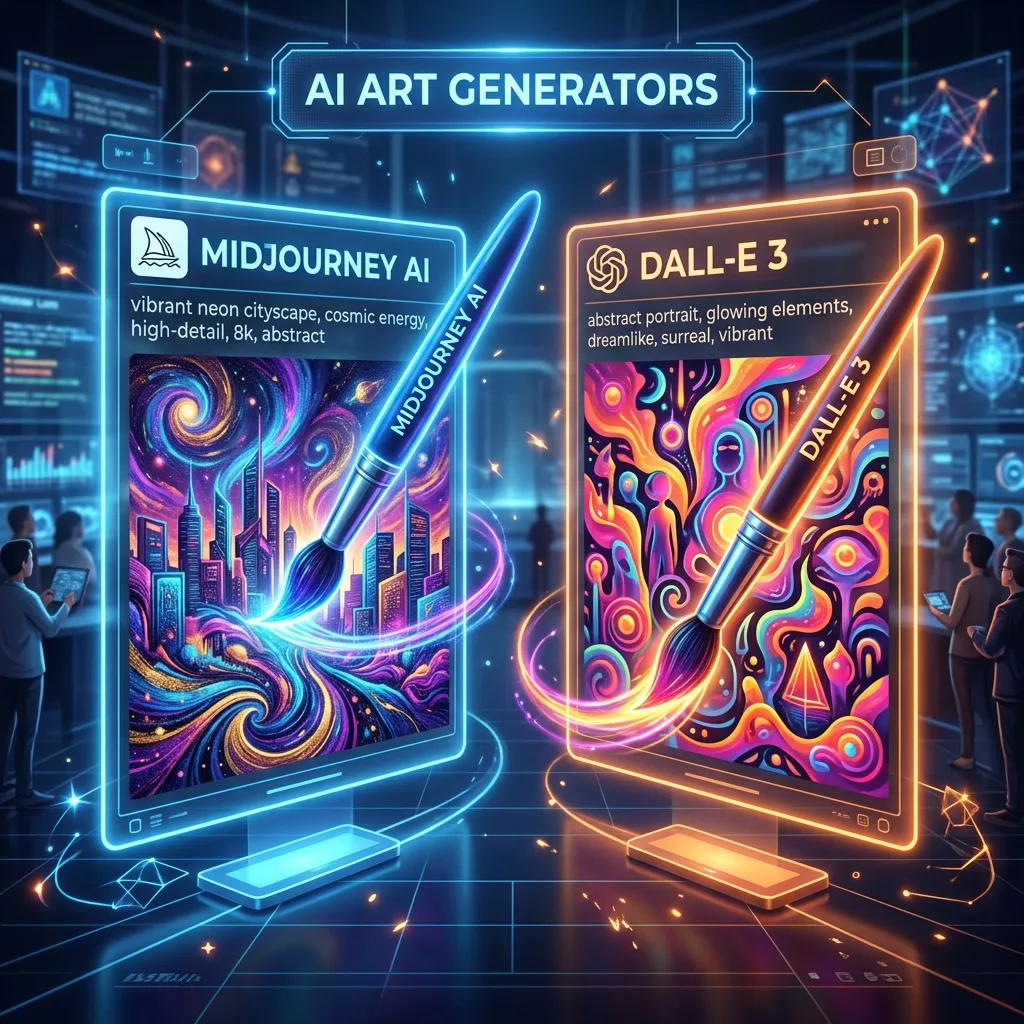
At the forefront of this visual revolution are two titans: Midjourney (an independent research lab) and DALL-E 3 (developed by OpenAI, the creators of ChatGPT).
While they both generate images from text prompts, their underlying philosophies are vastly different. Midjourney was built for artists; it prioritizes “vibe,” cinematic lighting, and breathtaking aesthetics. DALL-E 3 was built for the masses; it prioritizes literal interpretation, ease of use, and conversational prompting. Choosing the right tool depends entirely on whether you are trying to create a masterpiece or trying to generate a specific meme.
Deep Dive: Midjourney (v6)
Midjourney has cultivated a cult-like following among professional graphic designers, architects, and filmmakers. Its current model (v6) produces images so photorealistic that they are frequently mistaken for actual photographs.
The “Aesthetic Default”
Midjourney has a strong “opinion” on what looks good. If you give it a very simple prompt like “A coffee cup on a table,” Midjourney will automatically add dramatic studio lighting, depth of field, rich textures, and a cinematic color grading. It inherently wants to make your prompt look like it belongs in a high-end magazine.
The Discord Barrier
The largest complaint about Midjourney is its interface. To use it, you must use the Discord messaging app, type /imagine, and enter complex parameter codes like --ar 16:9 --stylize 250 --v 6.0. While they are slowly rolling out a web interface for power users, the Discord requirement creates a steep learning curve for non-technical users.
Deep Dive: DALL-E 3 (OpenAI)
DALL-E 3 was released with a singular goal: eliminate the need for complex “prompt engineering.” Because it is built natively into ChatGPT, you do not need to speak in code.
Conversational Prompting
With DALL-E 3, you can literally chat with the AI. You can say: “I need a logo for my bakery. It’s called ‘Sweet Treats.’ Make it look vintage.” ChatGPT will actually rewrite your simple prompt behind the scenes into a highly detailed paragraph, feed it to the image generator, and produce the logo. If you don’t like the colors, you just reply, “Make the background pastel pink instead,” and the AI adjusts the image perfectly.
Literal Adherence
DALL-E 3 is exceptionally good at following instructions. If you ask for three distinct objects on the left side of an image and two objects on the right, DALL-E will calculate the spatial geometry and execute it perfectly. Midjourney will often ignore your spatial instructions in favor of making the image “look cooler.”
Head-to-Head: Photorealism & Aesthetics
Winner: Midjourney.
This is not even a close contest. DALL-E 3 has a distinctly “plastic” or “video game” aesthetic. Human skin looks too smooth, and lighting often feels artificial. Midjourney excels at imperfections—it renders film grain, skin pores, messy hair, and complex reflections with terrifying accuracy. For high-end marketing, fashion photography, or architectural renders, Midjourney is the only acceptable choice.
Head-to-Head: UI/UX & Workflow
Winner: DALL-E 3.
For the average user, DALL-E 3 is a dream. You just open the ChatGPT app on your phone, type what you want, and the image appears. There are no /imagine commands or aspect ratio codes to memorize. Furthermore, you can use ChatGPT’s vision capabilities to upload a sketch you drew on a napkin, and ask DALL-E to turn that sketch into a 3D render.
Head-to-Head: Prompt Adherence & Text
Winner: DALL-E 3.
If you need an image of a neon sign that says “OPEN 24 HOURS,” DALL-E 3 will spell it perfectly 9 times out of 10. Midjourney v6 has improved, but it will often output something like “OPN 24 HORRS.” Additionally, if you give a prompt with 10 specific requirements (e.g., “The man must be wearing a green tie, a blue hat, holding a yellow umbrella, and standing on one foot”), DALL-E will hit all 10 requirements. Midjourney will likely drop the umbrella because it ruins the composition.
Pros & Cons: Midjourney vs. DALL-E 3
Pros of Midjourney (v6):
- Breathtaking, industry-leading photorealism and cinematic aesthetics.
- Incredible for generating UI/UX web design mockups and textures.
- Advanced parameter controls allow professionals to dial in exact stylization and chaos levels.
Cons of Midjourney:
- The Discord interface is clunky, chaotic, and intimidating for beginners.
- Struggles to spell long words or render exact logos accurately.
- Frequently ignores complex, multi-part instructions in favor of aesthetic composition.
Pros of DALL-E 3:
- Conversational editing—just tell ChatGPT what to change in plain English.
- Exceptional at rendering highly accurate text within images.
- Follows complex spatial instructions flawlessly.
Cons of DALL-E 3:
- Images often have an undeniable “AI look” (overly smooth, plastic lighting).
- Very strict safety filters will block you from generating images of real people, violence, or copyrighted characters.
- Cannot specify exact aspect ratios easily (it defaults to square, wide, or tall).
Comparison Table: Feature by Feature
| Feature | Midjourney (v6) | DALL-E 3 (OpenAI) |
|---|---|---|
| Subscription Cost | $10 – $30 / month | Included in ChatGPT Plus ($20/month) |
| User Interface | Discord (Web Alpha available) | ChatGPT Web & Mobile App |
| Aesthetic Quality | ⭐⭐⭐⭐⭐ (Masterpiece) | ⭐⭐⭐ (Cartoonish/Plastic) |
| Prompt Adherence | ⭐⭐⭐ (Ignores details) | ⭐⭐⭐⭐⭐ (Literal interpretation) |
| Text Generation | Okay (Short words only) | Excellent (Sentences and logos) |
| Safety Filters | Moderate (Allows some leeway) | Extremely Strict (Blocks public figures) |
Expert Verdict
“If you need an image that will make a client say ‘Wow,’ you must learn how to use Midjourney. The learning curve of Discord is worth the aesthetic payoff. However, if you are generating simple blog thumbnails, making memes, or need an image with very specific text on a sign, DALL-E 3 is the fastest, least frustrating tool on the market. Use DALL-E for utility; use Midjourney for art.” — Himanshu, Senior AI Automation Engineer
Frequently Asked Questions (FAQ)
Can I use these images commercially?
Yes. Both Midjourney (if you are a paying subscriber) and DALL-E 3 grant you full commercial rights to use, sell, and merchandise the images you generate. However, under current US law, you cannot copyright the raw AI image itself, meaning others can technically copy it.
Are there alternatives to Midjourney and DALL-E?
Yes. Stable Diffusion is the primary open-source alternative. Unlike Midjourney and DALL-E, which are run on cloud servers, Stable Diffusion can be run locally on your own computer (if you have a powerful GPU). It is completely uncensored and allows for massive technical control (via tools like ControlNet), but it requires significant technical skill to install and operate.
Why did DALL-E block my prompt?
DALL-E 3 has the strictest safety guardrails in the industry. It will instantly block any prompt that requests violence, sexual content, or the likeness of real public figures (e.g., “Taylor Swift eating a hotdog”). It will also block attempts to generate copyrighted characters like Mickey Mouse or Batman. Midjourney has similar filters, but they are slightly more forgiving regarding artistic nudity and public figures.
Conclusion
The choice between Midjourney and DALL-E 3 perfectly illustrates the current divide in generative AI: aesthetics versus control. Midjourney is a wild, untamed artist that produces masterpieces if you let it take the wheel. DALL-E 3 is a highly obedient graphic designer that does exactly what you ask, even if the result looks a bit generic. By understanding the strengths and weaknesses of each platform, AI Business leaders can equip their marketing and design teams with the precise tools needed to dominate visual storytelling in 2026. Explore more tool comparisons in our AI Reviews section.