Imagine two professionals starting the same assignment on Monday morning.
The first needs to prepare a board presentation explaining how artificial intelligence will affect the manufacturing industry over the next five years. The second has been asked to identify every major acquisition announced in that industry during the past six months, complete with supporting sources.
Both open an AI assistant.
Yet they shouldn’t necessarily open the same one.
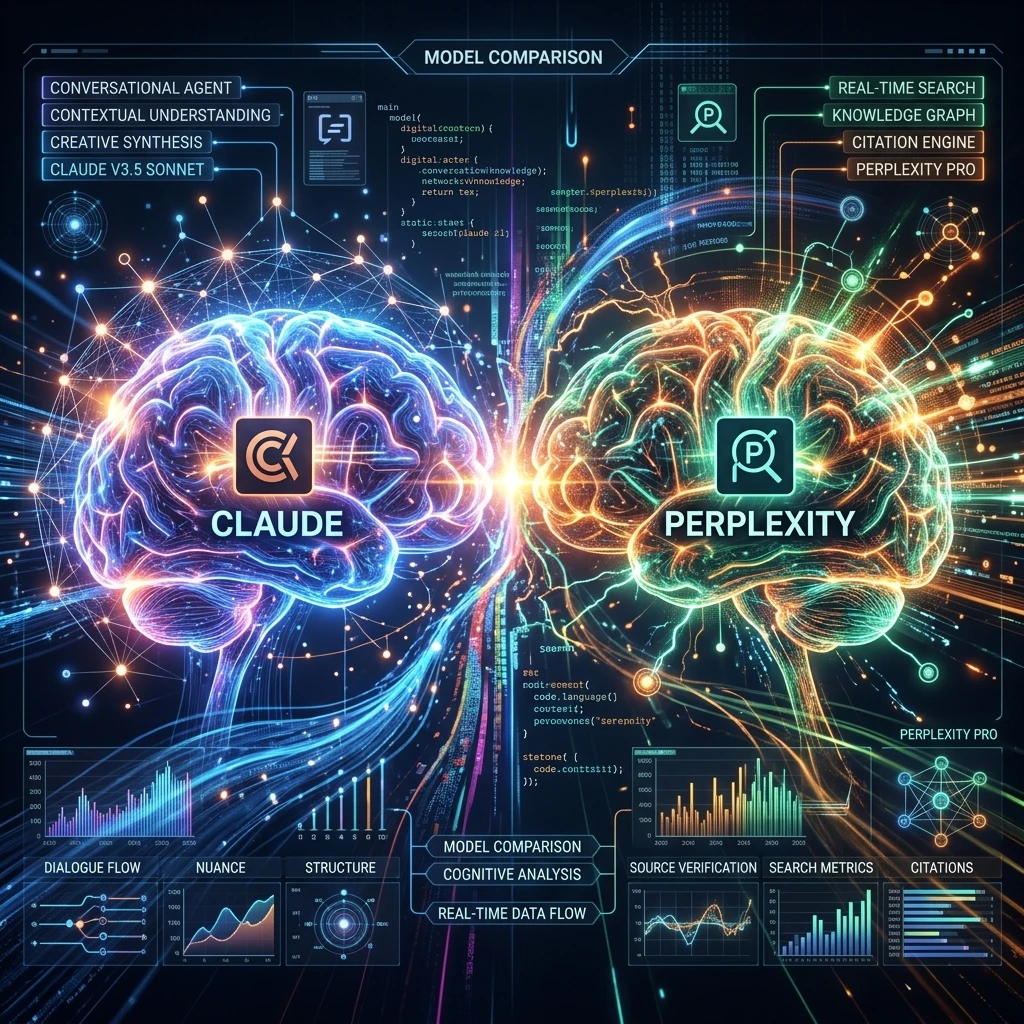
This is where many comparisons become misleading. Claude 3.5 Sonnet and Perplexity AI are often treated as direct competitors because both answer questions, summarize information, and assist with professional work. In reality, they were designed to solve different problems.
Claude is fundamentally a reasoning assistant. It excels when work requires analysis, writing, planning, coding, and sustained conversations.
Perplexity is fundamentally a research platform. It specializes in discovering, organizing, and citing current information from across the web.
Understanding that distinction immediately makes the buying decision easier.
- 1The First Decision: Are You Looking for Information or Insight?
- 2Why Writers Gravitate Toward Claude
- 3Why Researchers Often Begin With Perplexity
- 4Different Ways of Thinking
- 5Coding: Building Versus Looking Up
- 6Long Documents Reveal a Bigger Difference
- 7Where AI Fits Into a Professional Workflow
- 8Accuracy Isn’t Just About the AI Model
- 9Which Tool Saves More Time?
- 10Learning Curve
- 11Privacy and Enterprise Considerations
- 12Common Buying Mistakes
- 13When Using Both Makes Sense
- 14Final Verdict
The First Decision: Are You Looking for Information or Insight?
This is the question most buyers never ask.
Suppose your manager says:
“Find out what our three biggest competitors announced this month.”
The task is primarily about finding reliable information.
Now imagine a different request:
“Based on those announcements, recommend how our product strategy should change.”
The second task requires reasoning.
These two assignments look similar on paper, but they rely on different strengths.
Perplexity is designed to retrieve, organize, and reference information from current web sources, making it particularly effective for news monitoring, competitive intelligence, and fact-based research.
Claude shines once the information has already been gathered. It helps interpret patterns, compare strategies, develop recommendations, and communicate findings in a structured way.
Professionals often mistake one capability for the other.
Finding information is not the same as understanding it.
Why Writers Gravitate Toward Claude
Writing rarely happens in a single draft.
An executive summary becomes a report.
The report becomes a presentation.
The presentation becomes a proposal.
Each revision requires maintaining context while improving clarity.
This is where Claude has developed a strong reputation among consultants, analysts, researchers, and technical writers. Rather than simply producing text, it tends to preserve logical structure across long documents and adapt well to iterative editing workflows.
Consider preparing an annual strategy document.
You may ask the AI to:
- Rewrite technical language for executives.
- Expand one section.
- Shorten another.
- Maintain terminology across fifty pages.
- Improve transitions between chapters.
These tasks require sustained reasoning rather than isolated answers.
Claude generally handles this style of collaboration comfortably because conversations remain coherent over extended sessions.
Why Researchers Often Begin With Perplexity
Research is rarely about writing the final document.
It starts with gathering reliable material.
Suppose you’re investigating AI regulation in Europe.
Instead of opening dozens of browser tabs, copying links, and comparing publications manually, Perplexity searches, synthesizes, and presents results with citations, allowing users to verify the original sources more efficiently.
That workflow changes how professionals conduct research.
Rather than spending hours collecting information before analysis begins, they can move directly into evaluating the evidence.
This doesn’t eliminate fact-checking.
It simply shortens the path to it.
Different Ways of Thinking
One interesting difference between these tools isn’t technical at all.
It’s psychological.
Claude encourages exploration.
Users often ask:
“What would happen if…”
“Compare these strategies.”
“Challenge my assumptions.”
“Improve this argument.”
The conversation evolves naturally.
Perplexity encourages verification.
Questions are more likely to be:
“What happened?”
“Which sources support this?”
“When was this published?”
“What are experts saying?”
Neither style is better.
One develops ideas.
The other validates them.
Coding: Building Versus Looking Up
Developers rarely spend an entire day writing code.
Much of software engineering involves reading documentation, understanding unfamiliar libraries, comparing frameworks, debugging existing applications, and planning architecture.
Claude performs particularly well when programming requires sustained reasoning, such as refactoring code, explaining algorithms, generating documentation, or discussing architectural trade-offs over multiple iterations.
Perplexity becomes valuable earlier in the workflow.
Need to check the latest documentation?
Compare two recently released frameworks?
Find discussions about a newly published API?
Locate implementation examples?
These tasks align naturally with a research-first workflow.
Many experienced developers now use both.
Research with Perplexity.
Build with Claude.
Long Documents Reveal a Bigger Difference
Uploading a ten-page PDF is easy.
Uploading hundreds of pages of contracts, policy documents, or technical manuals is where enterprise users begin evaluating AI more seriously.
Claude has earned recognition for handling lengthy documents while maintaining context and producing structured summaries that preserve relationships between different sections. This makes it particularly useful for legal, consulting, compliance, and research work.
Perplexity also supports document analysis, but many professionals primarily use it to enrich uploaded material with external information.
Imagine reviewing a company’s annual report.
Claude might help explain strategic themes across the report.
Perplexity might identify recent industry developments that support—or contradict—the company’s claims.
Those are complementary strengths rather than competing ones.
Where AI Fits Into a Professional Workflow
Most professionals don’t rely on a single AI tool from start to finish.
Instead, work moves through several stages.
First comes information gathering.
Then analysis.
Then communication.
Finally, review and refinement.
Claude and Perplexity naturally fit into different parts of that sequence.
Consider a product manager preparing for a quarterly planning meeting.
The first task is understanding what’s happening in the market. Recent competitor launches, customer sentiment, analyst reports, and emerging technologies all need to be reviewed. Perplexity can significantly reduce the time spent collecting and organizing this information by surfacing relevant sources in one place.
Once the research is complete, the focus shifts.
Now the product manager needs to identify trends, evaluate strategic options, draft recommendations, and prepare presentation materials.
Those activities rely far more on reasoning than information retrieval, making Claude a strong companion for the second half of the project.
Rather than competing, the two platforms often complement one another throughout a typical workday.
Accuracy Isn’t Just About the AI Model
One misconception surrounding AI is that choosing the “best” model automatically guarantees accurate answers.
In reality, output quality depends on several factors:
- The quality of the prompt.
- The reliability of source material.
- The complexity of the task.
- The need for current information.
- Human review before decisions are made.
Perplexity makes verification easier by pointing users toward supporting sources. This encourages users to inspect the original material instead of accepting every generated response without question.
Claude, meanwhile, excels when accuracy depends on careful reasoning applied to information that has already been gathered. It can compare arguments, identify inconsistencies, summarize lengthy discussions, and explain complex ideas in language appropriate for different audiences.
Regardless of the platform, important business decisions should always involve independent verification.
Which Tool Saves More Time?
Time savings depend entirely on the type of work being performed.
A journalist researching a breaking story may save hours using Perplexity because it accelerates source discovery.
A consultant writing a fifty-page strategy report may save even more time with Claude because it assists throughout multiple drafting and editing cycles.
Similarly:
- Students often begin with research before moving to writing.
- Developers research documentation before implementing solutions.
- Analysts gather data before producing reports.
- Marketing teams investigate trends before creating campaigns.
The “faster” tool changes as the project progresses.
Learning Curve
Both platforms are accessible, but they reward different habits.
Perplexity feels familiar because its workflow resembles an intelligent search engine. Users ask questions, review cited answers, follow references, and continue exploring related topics.
Claude rewards iterative conversations.
Users who provide detailed context, request revisions, challenge assumptions, and refine outputs over multiple exchanges generally achieve stronger results than those expecting a perfect answer from a single prompt.
Neither approach requires technical expertise, but understanding each platform’s strengths significantly improves productivity.
Privacy and Enterprise Considerations
Organizations evaluating AI should consider more than response quality.
Questions worth asking include:
- How is organizational data handled?
- Can administrators control employee access?
- What integrations are available?
- Does the platform align with internal security policies?
- How easily can AI fit into existing workflows?
For enterprises, governance often becomes just as important as model performance.
An excellent AI assistant delivers limited value if it cannot be deployed responsibly within an organization’s operational and regulatory requirements.
Common Buying Mistakes
Many organizations evaluate AI assistants using unrealistic tests.
One common mistake is asking each platform to perform identical tasks without considering its intended purpose.
For example, criticizing Claude because it doesn’t prioritize live web research ignores what it was designed to do.
Likewise, evaluating Perplexity solely on long-form writing quality overlooks its primary role as a research assistant.
Another mistake is assuming employees need only one AI platform.
Different departments often have different priorities.
Legal teams.
Marketing.
Engineering.
Finance.
Research.
Each may benefit from different workflows.
Successful AI adoption focuses on solving business problems rather than standardizing every employee on the same tool.
When Using Both Makes Sense
Many experienced professionals no longer choose between Claude and Perplexity.
Instead, they combine them.
A practical workflow might look like this:
- Research a topic using Perplexity.
- Review cited sources for accuracy.
- Collect the most relevant findings.
- Move those findings into Claude.
- Ask Claude to identify patterns, evaluate alternatives, or produce reports.
- Refine the final document through iterative editing.
This approach combines current information with deeper reasoning.
It also reduces the temptation to rely on a single platform for every stage of complex work.
Final Verdict
The comparison between Claude 3.5 Sonnet and Perplexity AI becomes much simpler once their roles are understood.
Claude is best viewed as an analytical collaborator. It excels when professionals need to think through difficult problems, refine complex writing, review lengthy documents, generate code, or develop strategic recommendations through extended conversations.
Perplexity is best viewed as a research assistant. It helps users discover current information, compare multiple sources, monitor industry developments, and verify claims with considerably less manual searching.
Neither platform replaces the other because they solve different challenges.
If your work depends primarily on reasoning, writing, planning, document analysis, or sustained collaboration, Claude is likely to become the more valuable daily assistant.
If your day revolves around gathering current information, validating facts, tracking market developments, or conducting competitive research, Perplexity will often provide a more efficient starting point.
For many professionals in 2026, the most effective workflow is not choosing one over the other. It is knowing when to research, when to reason, and which AI is best suited to each stage of the work.