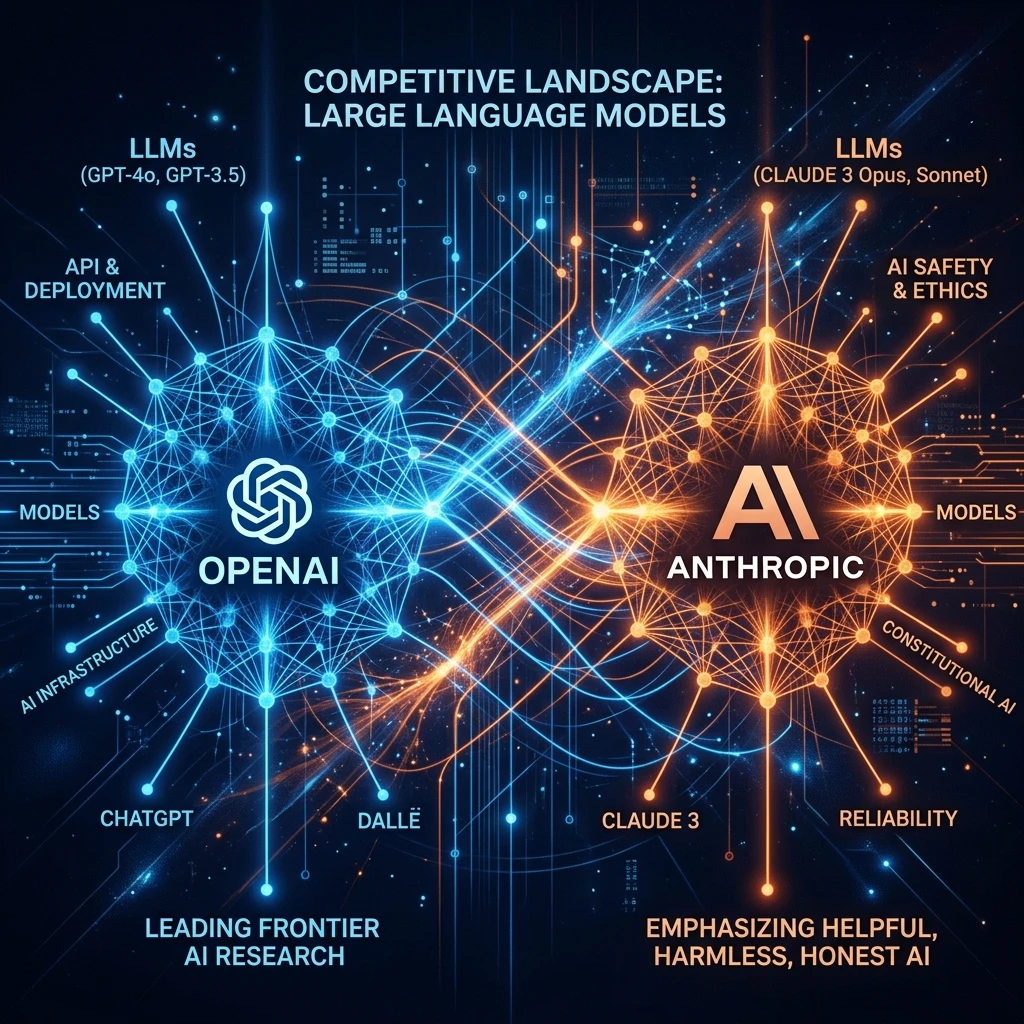
The competition between OpenAI and Anthropic is no longer just about who builds the smartest AI model.
It has become a contest between two philosophies.
One believes the future belongs to AI that becomes deeply integrated into everyday work through agents, multimodal experiences, developer platforms, and consumer products. The other has focused heavily on building AI systems that emphasize reliability, careful reasoning, and safety as foundational design principles.
Every new model release, enterprise partnership, research paper, and product announcement reflects these different priorities. Although both companies are pursuing increasingly capable AI, the paths they have chosen reveal contrasting ideas about what businesses and individuals will need over the next decade.
For organizations evaluating AI platforms in 2026, the decision is no longer simply “Which model answers questions better?” It is increasingly, “Which ecosystem do we want to build our future around?”
- 1The Industry Has Changed Faster Than Most Expected
- 2OpenAI’s Vision: AI as an Everyday Workspace
- 3Anthropic’s Vision: AI as a Trusted Reasoning Partner
- 4Different Companies, Different Definitions of Success
- 5Enterprise Buyers Care About Different Questions
- 6The Coding Race Has Become a Strategic Battlefield
- 7The Ecosystem Advantage
- 8Enterprise Adoption Is Becoming the Real Battleground
- 9Safety Is No Longer a Side Conversation
- 10Developers Are Choosing Ecosystems, Not Just Models
- 11Regulation Is Shaping the Competition
- 12The Cost of AI Extends Beyond Subscription Fees
- 13Which Organizations May Prefer OpenAI?
- 14Which Organizations May Prefer Anthropic?
- 15Could the Market Support Both?
- 16Final Perspective
The Industry Has Changed Faster Than Most Expected
Only a few years ago, generative AI was primarily associated with chatbots capable of answering questions or writing marketing copy.
That perception has changed dramatically.
Modern AI systems now support:
- Software development.
- Customer service.
- Scientific research.
- Financial analysis.
- Legal document review.
- Sales automation.
- Enterprise search.
- Workflow orchestration.
- Digital assistants capable of completing multi-step tasks.
This evolution has shifted the competitive landscape.
Instead of competing solely on model intelligence, OpenAI and Anthropic increasingly compete across infrastructure, enterprise adoption, developer tooling, and long-term platform strategy.
OpenAI’s Vision: AI as an Everyday Workspace
OpenAI has gradually expanded beyond conversational AI into a broader productivity ecosystem.
Its strategy increasingly centers on making AI a practical tool that employees use throughout the workday rather than only when asking isolated questions.
This includes capabilities for writing, coding, image generation, data analysis, automation, and AI agents capable of handling more complex workflows. The company has also continued expanding enterprise offerings and developer tools, reinforcing its goal of making AI a central layer across business operations.
The underlying idea is straightforward.
Instead of opening separate applications for research, coding, presentations, and automation, users increasingly interact with AI as a unified workspace.
That vision appeals particularly to organizations seeking a single platform capable of supporting multiple departments.
Anthropic’s Vision: AI as a Trusted Reasoning Partner
Anthropic has approached the market from a different direction.
From its earliest public work, the company emphasized building AI systems that are reliable, interpretable, and aligned with human intentions. This philosophy continues to shape both its research and commercial products.
Rather than competing primarily on the number of consumer-facing features, Anthropic has concentrated on areas such as:
- Long-document reasoning.
- Enterprise writing.
- Coding assistance.
- Safety research.
- Constitutional AI.
- Transparent model behavior.
This approach has resonated with many organizations whose workflows depend on careful analysis rather than rapid content generation.
Legal teams.
Researchers.
Consultants.
Policy analysts.
Software engineers.
These users often value consistency and structured reasoning as much as raw speed.
Different Companies, Different Definitions of Success
One of the easiest ways to understand the rivalry is to imagine two CEOs answering the same question:
“What should AI become?”
OpenAI’s answer increasingly resembles:
“An intelligent operating system for work.”
Anthropic’s answer is closer to:
“A dependable collaborator capable of helping people think more clearly and safely.”
Neither ambition excludes the other.
In fact, both companies increasingly overlap.
The difference lies in emphasis.
OpenAI continues investing heavily in broad product ecosystems, developer platforms, multimodal experiences, and agentic workflows. Anthropic has focused more intensely on reasoning quality, coding performance, and safety-oriented research, although it too has expanded enterprise capabilities considerably.
Enterprise Buyers Care About Different Questions
Consumers often compare AI models by asking which one writes better poems or answers trivia questions more accurately.
Enterprise buyers ask different questions.
Can the platform integrate with existing software?
Will employees adopt it?
How difficult is governance?
Does it meet compliance requirements?
How easily can developers build applications around it?
Can administrators control access?
How reliable are outputs across thousands of business interactions?
These operational considerations frequently outweigh benchmark scores.
Recent enterprise surveys suggest OpenAI currently maintains broader enterprise adoption, while Anthropic continues to gain traction in organizations that prioritize reasoning quality and coding workflows.
The Coding Race Has Become a Strategic Battlefield
Software development has become one of the most important AI use cases.
Developers now rely on AI for:
- Explaining unfamiliar code.
- Refactoring applications.
- Writing documentation.
- Debugging.
- Generating unit tests.
- Reviewing pull requests.
- Planning software architecture.
This area has become increasingly competitive.
Anthropic has earned recognition for strong coding performance and long-context reasoning, while OpenAI has expanded its own developer ecosystem with increasingly sophisticated coding and agent capabilities. Independent comparisons often conclude that both platforms perform at a very high level, with strengths varying by workflow rather than one being universally superior.
For engineering teams, the decision increasingly depends on how AI fits into existing development environments rather than benchmark scores alone.
The Ecosystem Advantage
Perhaps the biggest difference between these companies is no longer the language model itself.
It’s everything surrounding it.
OpenAI has invested heavily in creating an ecosystem that includes APIs, enterprise deployments, multimodal capabilities, developer tooling, and AI agents capable of assisting across multiple business functions.
Anthropic has also expanded its enterprise platform and developer offerings, but it has generally emphasized interoperability, responsible deployment, and high-quality reasoning over building an expansive consumer ecosystem.
As enterprise AI matures, organizations are increasingly choosing not just a model, but a long-term technology platform.
Enterprise Adoption Is Becoming the Real Battleground
For consumers, the difference between OpenAI and Anthropic may appear to revolve around chat interfaces or writing quality.
For enterprises, the decision is much broader.
Organizations evaluating frontier AI increasingly ask questions such as:
- Can the platform integrate with existing business systems?
- How much administrative control does it provide?
- Can developers build internal AI applications easily?
- Does it support company-wide deployment?
- How well does it protect sensitive business information?
- Is the vendor investing in long-term enterprise support?
OpenAI has continued expanding its enterprise strategy with products focused on organization-wide deployment, AI agents, developer tooling, and business productivity. The company’s stated direction emphasizes enabling AI across entire organizations rather than limiting it to isolated use cases.
Anthropic has also expanded its enterprise ambitions, including professional services and enterprise deployment support aimed at helping organizations move from AI experimentation to production environments.
The competition is no longer about selling subscriptions.
It is about becoming the default AI platform inside modern businesses.
Safety Is No Longer a Side Conversation
A few years ago, AI safety discussions were largely confined to researchers and policymakers.
Today, they influence procurement decisions.
Banks.
Healthcare providers.
Government agencies.
Large enterprises.
These organizations increasingly evaluate how AI systems behave when handling ambiguous instructions, sensitive information, or potentially harmful requests.
Anthropic has made safety one of its defining characteristics through its Constitutional AI approach, publishing detailed documentation describing the principles used to guide Claude’s behavior and updating that framework as the technology evolves.
OpenAI has similarly published model specifications, safety evaluations, and deployment frameworks while expanding safeguards alongside increasingly capable models. Both companies continue investing heavily in alignment research, although their methodologies differ.
For enterprise buyers, the practical question isn’t which company talks more about safety.
It’s which approach aligns with the organization’s risk profile and governance requirements.
Developers Are Choosing Ecosystems, Not Just Models
Software developers rarely evaluate an AI model in isolation.
They consider everything surrounding it.
Documentation.
APIs.
SDKs.
Latency.
Reliability.
Pricing.
Deployment options.
Tooling.
Community support.
OpenAI has invested heavily in building a broad developer ecosystem, allowing companies to embed AI into customer support systems, coding assistants, internal knowledge platforms, automation tools, and enterprise applications.
Anthropic has focused on making Claude attractive for complex reasoning, long-context tasks, and enterprise-grade development workflows, particularly where careful analysis and structured outputs are priorities.
As AI becomes part of everyday software development, these surrounding ecosystems often matter more than marginal differences in benchmark performance.
Regulation Is Shaping the Competition
The future of frontier AI will not be determined by technical progress alone.
Governments around the world are introducing frameworks governing transparency, safety testing, copyright, data protection, and deployment of advanced AI systems.
For companies operating internationally, regulatory readiness is becoming part of platform evaluation.
Organizations increasingly need to understand:
- How vendors document safety practices.
- Whether enterprise controls support compliance.
- How customer data is handled.
- What governance features are available.
- How rapidly vendors respond to regulatory changes.
The regulatory landscape continues to evolve, particularly as jurisdictions implement comprehensive AI legislation and oversight mechanisms.
The Cost of AI Extends Beyond Subscription Fees
Pricing comparisons often overlook implementation costs.
Organizations adopting frontier AI should also consider:
- Employee training.
- Workflow redesign.
- Prompt development.
- Internal governance.
- API usage.
- Integration projects.
- Ongoing monitoring.
A platform that appears less expensive on paper may require significantly greater operational investment if teams struggle to integrate it into existing processes.
Likewise, a more expensive platform may produce stronger returns if it becomes central to employee productivity.
The most valuable AI investment is rarely the cheapest one.
It is the one employees consistently use.
Which Organizations May Prefer OpenAI?
OpenAI is often an attractive choice for organizations that want AI to support a broad range of business activities.
Examples include:
- Marketing teams producing content.
- Customer support organizations.
- Product teams.
- Data analysts.
- Software developers.
- Companies seeking AI agents across multiple workflows.
Its expanding ecosystem makes it well suited to businesses looking for a versatile AI platform rather than a narrowly focused assistant.
Which Organizations May Prefer Anthropic?
Anthropic frequently appeals to organizations where careful reasoning and reliability receive particular emphasis.
Examples include:
- Legal practices.
- Consulting firms.
- Research organizations.
- Financial analysis teams.
- Policy groups.
- Software engineering departments working with complex documentation.
Its emphasis on long-context reasoning and transparent alignment philosophy has made it particularly attractive for knowledge-intensive work.
Could the Market Support Both?
History suggests it probably can.
Enterprise software rarely produces a single winner.
Organizations routinely use multiple cloud providers.
Multiple productivity suites.
Multiple security platforms.
AI may follow a similar path.
Some departments may prioritize OpenAI because of its broad ecosystem and productivity features.
Others may adopt Anthropic for specialized analytical or reasoning tasks.
Competition between the two companies is therefore likely to encourage continued innovation rather than eliminate one platform.
Final Perspective
The rivalry between OpenAI and Anthropic represents more than a race to build increasingly capable language models. It reflects two distinct ideas about how artificial intelligence should evolve.
OpenAI is building an expansive ecosystem where AI becomes a core layer of productivity, software development, automation, and enterprise operations. Its strategy focuses on making AI broadly useful across countless workflows and applications.
Anthropic has concentrated on creating AI that organizations can trust with complex reasoning, long-form analysis, and high-stakes professional work while continuing to invest heavily in alignment and governance. Its Constitutional AI framework remains a defining part of that vision.
For businesses, the most important decision is unlikely to be which company wins the headlines. The better question is which platform aligns with the organization’s objectives, technical environment, governance requirements, and long-term AI strategy.
As AI continues to mature, success will depend less on selecting the most powerful model available today and more on choosing an ecosystem capable of evolving alongside the business itself.