- 1Key Takeaways
- 2Table of Contents
- 3Understanding the Core Difference
- 4Perplexity AI: The End of Traditional Search
- 5Claude 3.5 Sonnet: The Cognitive Workstation
- 6Head-to-Head: Coding & Development
- 7Head-to-Head: Writing & Copywriting
- 8Feature Comparison Table
- 9Pros & Cons of Each Platform
- 10Expert Insights
- 11Frequently Asked Questions (FAQ)
- 12Conclusion
Key Takeaways
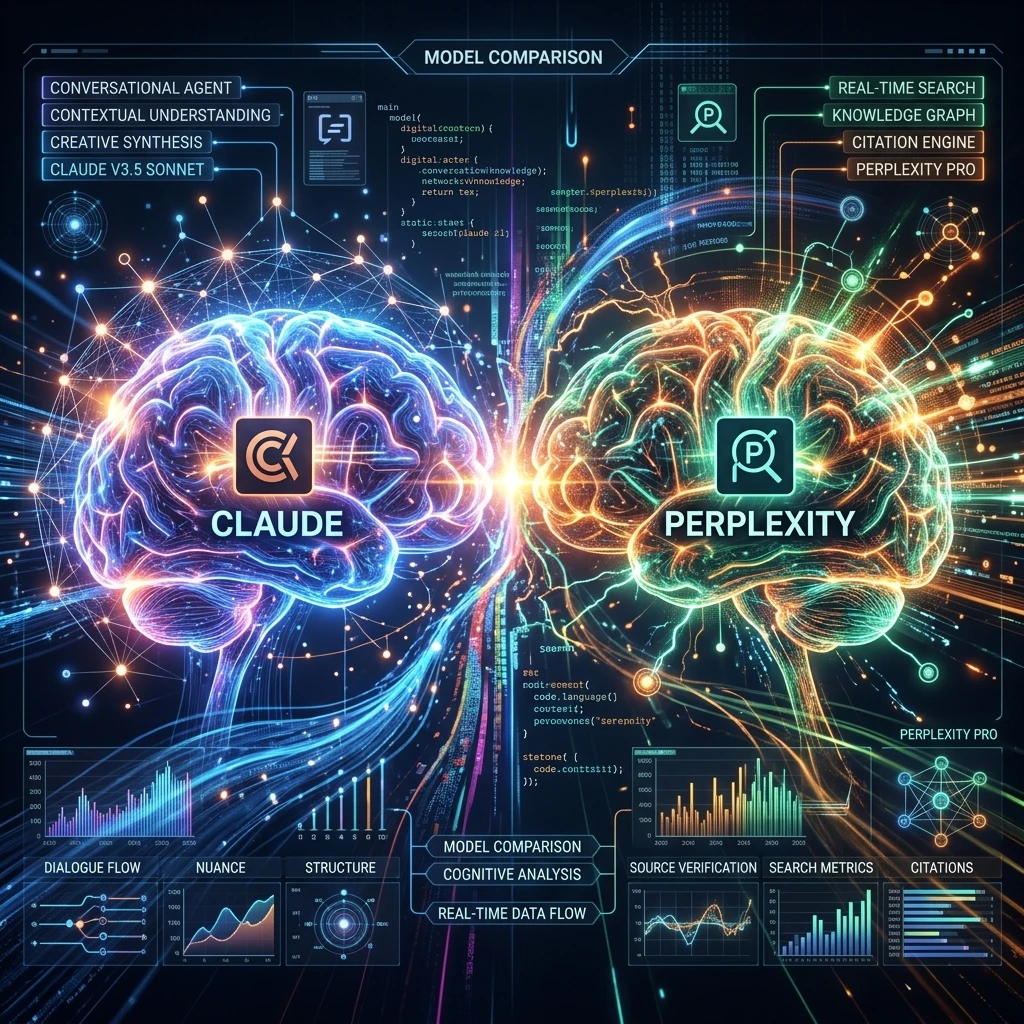
- Fundamentally Different Tools: Do not treat them as identical chatbots. Claude is a deep-thinking cognitive engine (a synthesizer); Perplexity is an internet-connected answer engine (a researcher).
- Perplexity for Research: If you need hard facts, live stock prices, or academic citations, Perplexity AI is vastly superior. It searches the live web and provides footnotes to verify every claim, eliminating hallucinations.
- Claude for Creation: If you need to write a 3,000-word essay, architect a complex React codebase, or analyze a 100-page PDF, Claude 3.5 Sonnet’s 200K context window and superior logical reasoning make it the undisputed king.
- The Artifacts Advantage: Claude’s “Artifacts” UI allows users to generate and instantly preview live code, vector graphics, and interactive dashboards, making it the preferred tool for developers and designers.
- The Ultimate Tech Stack: Professionals in 2026 do not choose one over the other. The standard workflow is to use Perplexity to gather the factual research, and then feed that research into Claude to synthesize the final product.
Understanding the Core Difference
The biggest mistake new users make when entering the AI Business space is treating all AI tools like Google. They type a question into a box and expect the same result.
To understand Claude 3.5 Sonnet and Perplexity AI, you must understand their underlying architecture.
- Claude is a “closed-book” genius. Imagine locking a brilliant professor in a room with a typewriter and a 500-page PDF. They cannot look at the internet, but they can analyze the document you gave them with profound, nuanced intelligence.
- Perplexity is the ultimate librarian with a high-speed internet connection. It does not try to be the genius. Instead, it instantly reads 20 different websites, extracts the exact facts you need, and synthesizes a summary with precise footnotes pointing to the source material.
You use Perplexity to find the truth. You use Claude to build with the truth.
Perplexity AI: The End of Traditional Search
Google Search is dying under the weight of SEO spam and affiliate links. When you search Google for “Best CRM for Dentists,” you get 10 pages of sponsored ads and 2,000-word blog posts that bury the answer.
How Perplexity Solves This:
Perplexity functions as an “Answer Engine.” When you ask it the same question, it autonomously browses the top 15 results, reads them, and generates a concise, 3-paragraph answer: “The top three CRMs for dentists are X, Y, and Z. X is best because [Citation 1]. Y integrates with Dentrix [Citation 2].”
The Pro Search Feature:
If you pay for Perplexity Pro, it unlocks “Pro Search.” This is an iterative reasoning engine. If you ask a complex question, Perplexity pauses and asks you clarifying questions before it searches.
User:* “What are the zoning laws for commercial real estate in Austin?”
Perplexity Pro:* “Are you looking for retail, industrial, or mixed-use zoning? And which specific zip code?”
By forcing context, Perplexity guarantees that the final answer is factually accurate, heavily cited, and free of the “hallucinations” that plague standard LLMs.
Claude 3.5 Sonnet: The Cognitive Workstation
While Perplexity shines at fetching data, Anthropic’s Claude 3.5 Sonnet shines at manipulating data.
The 200K Context Window:
Claude can “hold” massive amounts of information in its active memory. A lawyer can upload three different 50-page legal contracts and prompt: “Identify any conflicting non-compete clauses between these three documents.” Claude will perform this analysis flawlessly. Perplexity cannot handle document analysis at this scale.
The “Artifacts” UI:
This is Claude’s killer feature. When you ask Claude to write code (like a Python script, a React component, or a Mermaid.js diagram), it doesn’t just output raw text. It opens a secondary window on the right side of the screen called an “Artifact” and renders the code live. You can instantly see the website or dashboard you just asked it to build, making it the ultimate tool for rapid prototyping.
The Natural Writer:
Claude is widely considered the best AI for writing. It lacks the robotic, overly-enthusiastic tone of ChatGPT. It writes with natural cadence, varied sentence structure, and deep emotional nuance.
Head-to-Head: Coding & Development
The Winner: Claude 3.5 Sonnet
For software engineers, this is not a contest. Claude 3.5 Sonnet is currently the undisputed champion of zero-shot code generation and architectural reasoning.
- If you paste a 1,000-line broken Python script into Claude, it will understand the underlying logic, identify the memory leak, and rewrite the function flawlessly.
- Its integration into AI IDEs (like Cursor and Windsurf) has made it the default engine for professional developers.
- Perplexity is useful if you need to search the web for the documentation of a brand-new API that was released yesterday, but it is not built to write or debug large codebases.
Head-to-Head: Writing & Copywriting
The Winner: Claude 3.5 Sonnet (With a caveat)
If you are writing a creative essay, a sales email, or a blog post, Claude’s tone is infinitely superior. It is the only AI that can pass the “human test” without aggressive editing.
However, if you are writing a heavily researched academic paper or an investigative journalism piece, you must use Perplexity first. You use Perplexity to gather the facts, dates, and citations. You then take that factual outline, paste it into Claude, and say: “Use these verified facts to write a beautifully engaging, 1,000-word article.” This is the ultimate “Cyborg” workflow.
Feature Comparison Table
| Feature | Claude 3.5 Sonnet | Perplexity AI |
|---|---|---|
| Primary Use Case | Coding, Writing, Data Synthesis | Factual Research, Web Browsing |
| Live Web Access | Very Limited (Beta) | Exceptional (Core Feature) |
| Hallucination Risk | Medium (if asked for facts) | Very Low (due to citations) |
| Coding & UI (Artifacts) | Best in Class | Basic |
| Context Window (Memory) | Massive (200K tokens / ~150k words) | Small (Relies on search retrieval) |
| Writing Tone | Highly Natural & Nuanced | Clinical, Factual, Academic |
Pros & Cons of Each Platform
Pros of Claude 3.5 Sonnet:
- The “Artifacts” feature revolutionizes how non-technical users interact with code and design.
- The most human-sounding writing model on the market, perfect for marketers and copywriters.
- Capable of ingesting and analyzing massive datasets (entire books, multiple PDFs) flawlessly.
Pros of Perplexity AI:
- The absolute best tool for factual research, entirely replacing Google Search.
- Provides real-time clickable footnotes to verify every single claim, destroying the “hallucination” problem.
- The “Pro Search” feature acts as a research assistant, asking clarifying questions before executing complex web scrapes.
Cons of Both:
- Claude: Does not natively browse the live web effectively, making it useless for finding today’s stock prices or breaking news.
- Perplexity: Terrible at creative writing. Its tone is dry, and it cannot handle massive 100-page document uploads for deep synthesis like Claude.
Expert Insights
“The tribalism of ‘Which AI is better?’ is a symptom of amateur thinking. A carpenter doesn’t argue whether a hammer is better than a saw; he uses both to build a house. Perplexity is your research department. It gathers the raw materials and verifies the truth. Claude is your executive creative director. It takes those raw materials and architects them into a masterpiece. If you want to operate at the elite level in 2026, you pay the $20/month subscription for both.” — Himanshu, Senior AI Automation Engineer
Frequently Asked Questions (FAQ)
Does Perplexity use its own AI model?
No, Perplexity is an “aggregator” and an interface. When you use Perplexity Pro, you can actually choose which underlying model powers the reasoning engine. You can go into settings and tell Perplexity to use GPT-4o, Claude 3.5 Sonnet, or open-source models like Llama 3 to process the search results.
Which tool is better for a college student?
Perplexity. For academic work, citations are everything. If a student uses Claude to write a history paper, Claude might invent a fake historical date. If a student uses Perplexity, every fact will have a footnote linking directly to a verified academic source or credible website.
Is Claude 3.5 Sonnet better than ChatGPT (GPT-4o)?
For writing and coding, the industry consensus is yes. Claude’s logical reasoning and natural tone have surpassed GPT-4o. However, ChatGPT remains the best “all-in-one” tool because of its superior Voice Mode (for talking on your phone) and its native DALL-E 3 image generation, which Claude currently lacks.
Conclusion
The evolution of artificial intelligence has moved past the era of the “generic chatbot.” We are now in the era of specialized cognitive tools. Perplexity AI has successfully reinvented the search engine, providing instant, cited, and hallucination-free facts. Claude 3.5 Sonnet has reinvented the digital workstation, providing a massive context window and live-rendering UI for deep creative and technical execution. By understanding their distinct architectures, AI Business leaders can stop treating them as competitors and start utilizing them as a deeply integrated tech stack. To explore more tool comparisons and optimize your workflows, dive into our extensive AI Reviews directory.